Business Name: Manning Detail & Coatings
Address: 1812 W Sunset Blvd #30, St. George, UT 84770
Phone: (435) 572-0451
Manning Detail & Coatings
Manning Detail & Coatings is a mobile detailing and ceramic coating outfit that offers a shop, specializing in paint correction and ceramic coatings.
1812 W Sunset Blvd #30, St. George, UT 84770
Business Hours
Monday thru Sunday: 9:00am - 6:00pm
Facebook: https://www.facebook.com/manningdetail.coatings/ Instagram: https://www.instagram.com/manningdetailandcoatings/ YouTube: https://www.youtube.com/@manningdetailandcoatings
Detailers have a stating that sticks due to the fact that it holds true: coverings secure whatever you leave on the paint. They do not conceal defects, they preserve them. If you desire ceramic coating results that turn heads under filling station lights and midday sun, the real work takes place before the bottle ever opens. That work is paint correction, the mindful, systematic removal of swirl marks, haze, water spot etching, and oxidation that robs a finish of clearness. Finishing on top of jeopardized paint is like laminating a wrinkled image. Smooth the image initially, then protect it.
I have actually invested long days in stores and even longer days doing mobile detail tasks in driveways with less-than-ideal lighting. The pattern holds. The vehicles that look years more youthful after a ceramic coating are the ones that got patient correction first, tailored to the paint system and the owner's goals. The ones that dissatisfy usually hurried or skipped the correction step.
The larger purpose behind paint correction
Paint correction exists to restore a paint system's optical efficiency, not simply its gloss. When sunshine strikes paint, it either reflects cleanly or scatters on defects. Scattering kills depth and makes a glossy surface appearance dull and gray. Correction removes or considerably levels the micro-scratches and top-layer oxidation that trigger scatter. When the surface area reflects light in an uniform way, the clarity jumps, metal flake pops, and the paint looks "damp."
This isn't vanity. A tidy, leveled surface area permits ceramic coating to bond more evenly and with greater coverage density. That generally translates to much better hydrophobics, simpler washing, and more consistent toughness. In blunt terms, if you desire your finish to last closer to the top end of its ranking, the foundation matters.
How problems form, and what they do to coatings
Most swirls come from incorrect cleaning and drying. Unclean wash mitts, old bath towels, aggressive automatic car cleans with stiff brushes, and even a dusty fast information clean before a cars and coffee fulfill. RIDS, or random isolated deep scratches, often originated from keys grazing a pocket, a rogue zipper, or grit caught under a drying towel. Water spots are a double hazard: some are mineral deposits resting on the surface, others are engraved into the clearcoat by vaporized hard-water droplets that baked in the sun. Oxidation takes place as UV and oxygen break down the clearcoat's top layers, specifically on ignored or single-stage paints.
Coatings amplify what is already there. They include gloss due to the fact that they develop a smooth nano-level shell, however they will not remove a halo from a rotary burn or conceal a sanding mark that wasn't totally completed out. Even light haze from an aggressive substance step can weaken bond strength. Think about it like painting a wall; guide grabs much mobile detail better when the wall is smooth and tidy. The chemistry of ceramic coating wants a surgically prepped surface with very little oils, no waxes or sealants, and no ingrained contaminants.
The preparation that separates pros from shortcuts
Good car detailing starts long before a polisher touches paint. The prep phase is where you acquire or lose hours later.
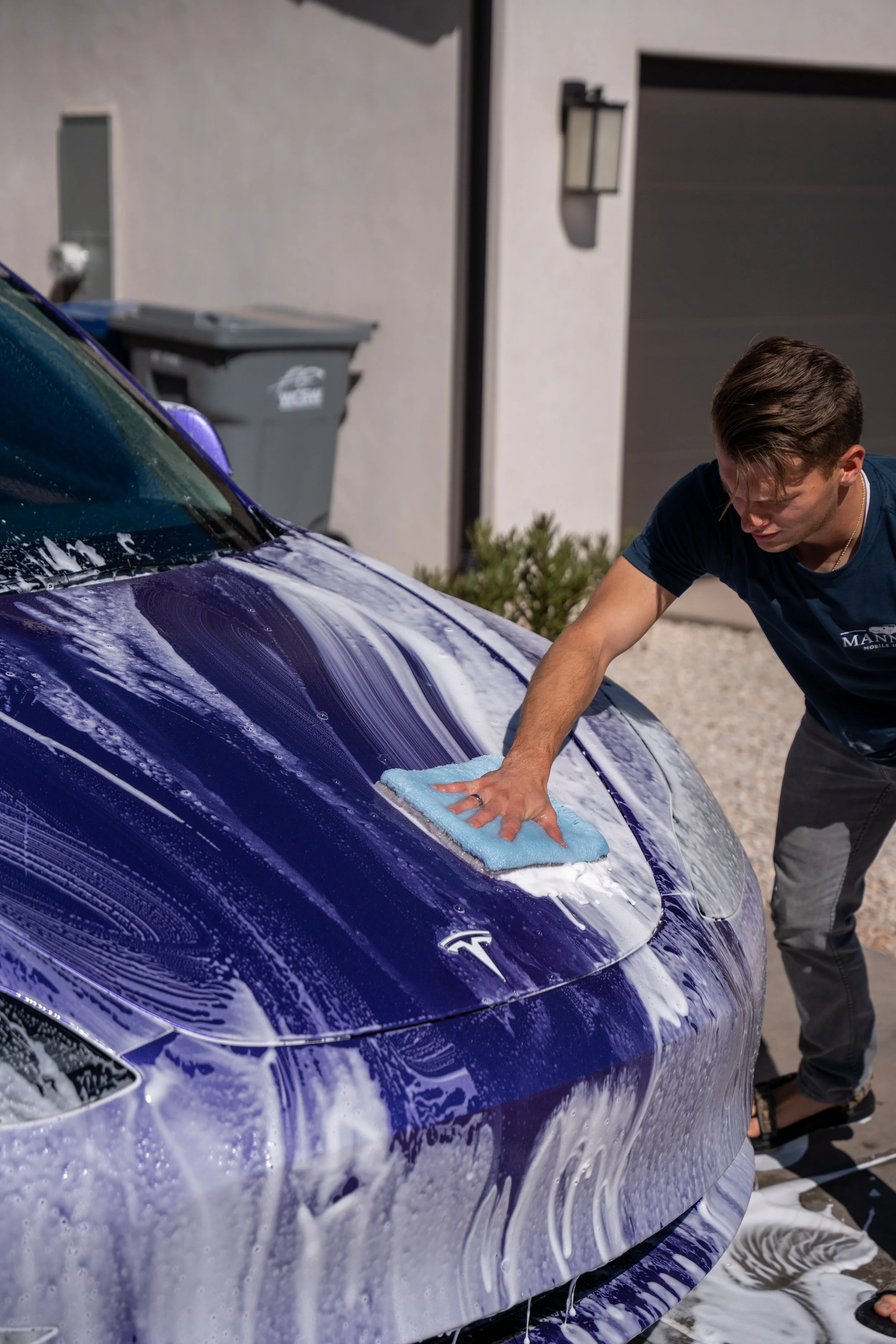
Start with an extensive rinse to shed loose grit. A pre-foam dwell helps oil and loosen up traffic film. A contact wash with clean containers, quality media, and regular rinsing keeps brand-new scratches at bay. Decontamination follows: an iron eliminator handle ferrous fallout, then a clay treatment slides away bonded pollutants like overspray and tar. If your clay bar grabs or chatters, you're refrained from doing. If it moves like ice, excellent. On soft paints, a clay alternative mitt conserves spoiling, however you still have to correct any micro-marring it introduces.
Once tidy, inspect. Pull the vehicle into much better light. Sunlight is honest but irregular, so I rely on a 5000K to 6500K LED swirl finder and cross-light from different angles. I keep a note pad and mark panels with tape. You would like to know where you'll spend time before you devote to a plan.
Finally, tape sensitive areas. Badges, textured plastic trim, and sharp edges will thank you. Edge burn-through often takes place when the pad kisses an unguarded joint. A couple of minutes of masking beats hours of regret.
Paint systems act differently, so adjust your approach
Not all clearcoats cut the exact same. German clear on a BMW or Audi frequently feels hard; it can manage a much heavier cut to eliminate problems. Japanese clear on some Toyota or Honda designs can be softer, which implies it remedies rapidly however likewise micro-mars easily and requires a gentler finish polish. American trucks and domestic sedans differ commonly across years and paint plants. Repaints include another variable. Body shop clear can be grabbier and often leaves solvent-sensitive footprints if you go too hot or too oily with compounds.
This is why test spots matter. On a front fender or door, run a little section with a moderate polish and polishing pad. Wipe with a suitable panel preparation service, examine, then step up if needed. If you get 80 percent flaw elimination with a medium polish on a yellow foam pad, you may not require to leap to microfiber cutting. If your objective is near-perfection on a show automobile, you'll likely do a compound step then refine. For an everyday chauffeur entering into a ceramic coating, I typically aim for sensible improvement: safely remove most swirls and all haze while preserving clearcoat thickness.
Understanding the three-step ladder: cut, polish, refine
Polishers, pads, and liquids are tools, not rules. Still, a basic ladder assists organize the work.
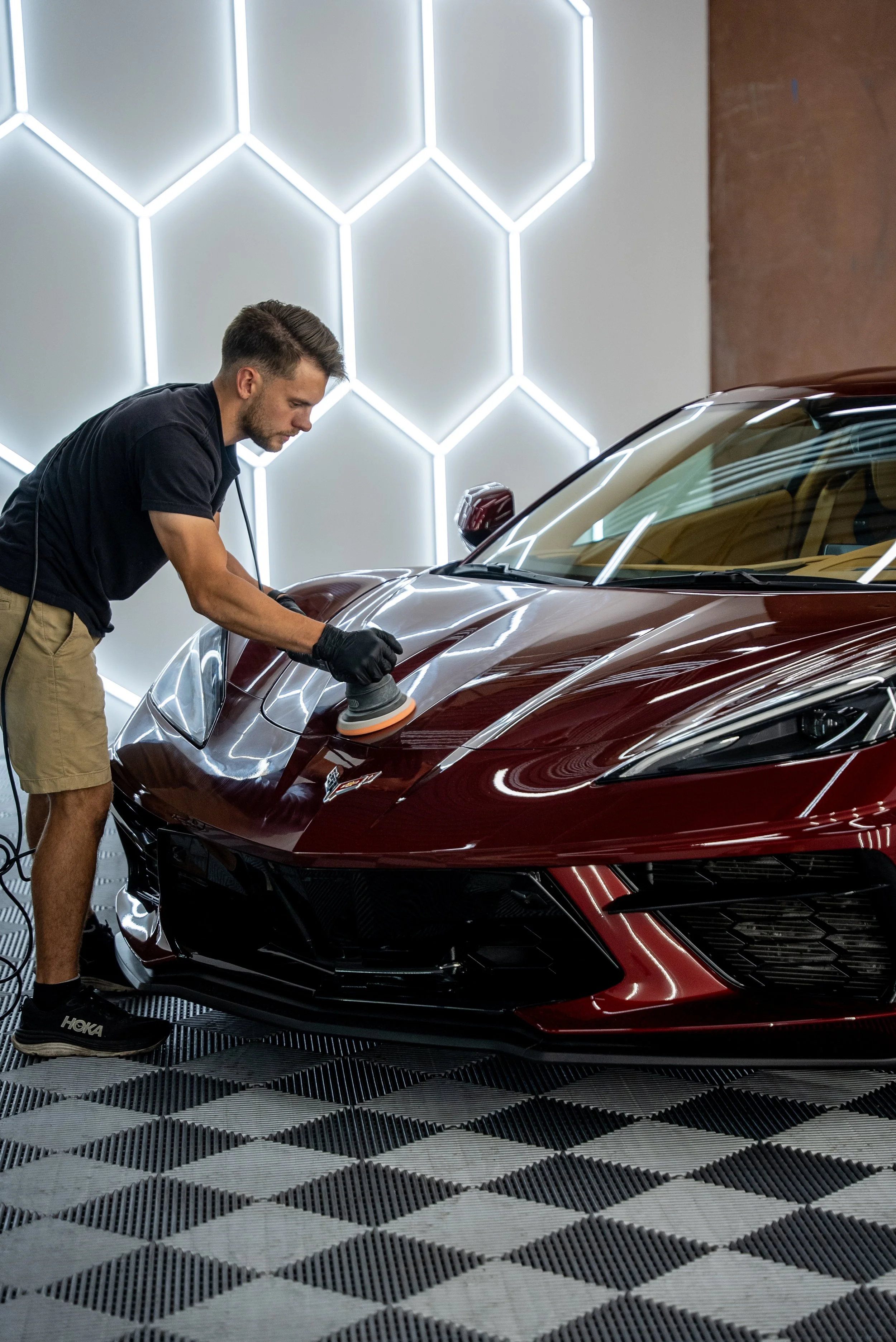
Cutting gets rid of defects by leveling the surrounding clearcoat. Microfiber or wool pads married to a diminishing or non-diminishing compound will tear down swirls and RIDS. Orbital throws differ, but a 15 to 21 millimeter long-throw dual-action maker balances cut and control. I use moderate pressure and sluggish, overlapping passes, then reduce pressure for a last sweep to clarify the finish.
Polishing cleans up the micro-marring left by the cut. Foam pads and a finer polish revive clarity and depth. Many contemporary polishes leave very little residue and surface prepared for covering after a proper clean. If your paint is soft, an ultra-fine polish on a finishing foam will make the distinction between "shiny" and "glass."
Refining is optional however worth it on dark colors. A jeweling pass with a finishing polish, low speed, and nearly no pressure can include that last little clarity. On a black S-Class I remedied last spring, the owner believed I had actually already covered it after the improve stage because the flake looked suspended under the clear.
When a single step is the smarter step
Not every lorry requires a two or three-step correction. For lighter colors or well-maintained cars, a single-step polish can enhance gloss by 40 to 60 percent while maintaining clear and saving hours. I have actually done single-step corrections on brand-new cars and trucks with transport marring that looked even worse than the client anticipated. That single action made the paint deserving of finish without risking density or blowing the budget.
The trick is selecting a flexible polish and pad combination that cuts a little and ends up tidy. Mild to medium polishes with modern abrasives paired with a foam polishing pad often deliver. If examination lights show moderate swirls, change technique rather than leaping right to heavy compound. Time saved on correction can be spent on tight edges, jambs, and trim, which clients notice simply as much.
Thickness and the invisible limitation of "best"
Clearcoat density on factory vehicles usually runs in the 2 to 3 mil range, with the color base and primer listed below. You can not see density with your eyes, so a paint depth gauge deserves its rate. I sweep panels and search for outliers. If one door reads 3.8 mils while the remainder of the vehicle sits at 4.8 to 5.2, that door has actually seen previous correction or a thinner application. You don't pursue best on panels like that. You pursue wise improvement.
Perfection goes after can thin edges or chase RIDS that must be softened, not eliminated. A scratch you can barely see at 2 feet is unworthy the microns it costs to completely remove it. Ceramic coating after a sensible correction provides you a high-impact surface with a margin for the future.
The chemistry dance: how correction supports finish adhesion
Ceramic finishes bond to paint by forming chemical and mechanical relate to the clearcoat surface. Oils, waxes, silicones, and filler residues from polishes can block those bonds. That is why the wipe-down matters. Panel preparation items built around isopropyl alcohol or committed solvent blends remove polishing oils without swelling the clearcoat. I prefer two light clean cycles instead of one heavy, aggressive wipe. A saturated towel can redeposit oils, so rotate towels frequently and keep them clean.
A genuinely corrected surface provides more predictable surface energy. Coatings level better and treat more uniformly when they aren't battling residues or micro-haze. The result is stronger water habits and less patchiness. On a remedied and well-prepped panel, you'll see beads round up tightly within minutes of the very first rinse post-cure.
Coating choice: match product to lifestyle, not hype
Ceramic finishing labels typically promise 5 to 7 years. Those numbers assume careful wash technique, covered parking, and proper prep. Real-world durability differs with environment, miles driven, and upkeep. I talk customers through usage cases. A daily motorist that lives outdoors and gets a weekly tunnel wash will not see the very same term as a garage-kept weekend vehicle that gets mild hand washes.
Some finishes are dense and harder, which can resist wash spoiling much better however feel grabby throughout application. Others are slicker and easy to use, perfect for mobile detail situations where temperature level and wind aren't perfect. I keep more than one system on the shelf for precisely this reason, and I'm transparent about re-topper schedules. A six-month topper session can stretch efficiency considerably and keep the finish feeling slick.
An example from the field: daily driver, remarkable change
A charcoal gray SUV came into my bay with 30,000 miles and heavy swirl marks from automated washes. The owner wanted ceramic coating to make it simpler to clean. On evaluation I found moderate swirls, a few water area etches on the hood, and common wash spoiling around door handles.
After a decon wash and iron elimination, I ran a test spot. A medium polish on a yellow foam pad got rid of about 70 percent of the swirls but left the much deeper marks. The owner didn't want a museum piece, so we agreed on a one-and-a-half step: a quick targeted cut on the worst panels, then a complete single-step polish across the car.
I taped trim, spot-corrected the hood, roofing system edges, and driver's door with a microfiber cutting pad and a low-dusting substance, then changed to foam and an ending up polish everywhere. The whole correction took approximately 6 hours. After two panel prep wipe cycles, I used a two-layer finishing and a ceramic coating Manning Detail & Coatings different wheel covering. The cloudy metallic ended up being crisp, the roof reflection appeared like a mirror at twelve noon, and the owner reported that weekly rinses shed 90 percent of gunk without contact. More notably, the finishing had a fair shot at lasting due to the fact that we didn't bury problems under it.
Shop versus mobile: managing the environment
Shops provide you stable lighting, climate control, and dust management. Coatings and polishes act predictably in between 60 and 75 degrees with moderate humidity. Mobile detail work presents windborne dust, direct sun, and temperature swings. You adapt. I bring shade canopies, corded and battery lights, and keep panels smaller to maintain control. I choose polishes that don't flash too quickly in heat and finishes with longer open times so leveling isn't a panic. Even small wins assist, like chilling applicator blocks in a cooler on very hot days to slow the treatment ceramic coating on contact.
If conditions are truly undesirable, I reschedule finishing application. I'll still carry out wash and correction so the return visit is quicker and easier. Clients value the honesty, and the outcomes validate the wait.
The wash after the shine: maintenance that secures your investment
Coatings are not armor against bad wash practices. Two-bucket or rinseless strategies with tidy towels, pH-neutral soaps, and soft brushes make the distinction in between a finish that holds its clarity and one that turns gray again. Touchless washes are a safe fallback however typically underperform on roadway movie. For winter, I suggest a mild pre-wash with a pump sprayer and a rinseless wash in a heated garage or do it yourself bay.
An easy upkeep rhythm works: gentle wash every one to 2 weeks, a decon rinse or topper every couple of months depending on weather, and a yearly examination. Covering toppers can restore slickness that naturally declines after a couple of months. If you feel towels get more than they did initially, that's your hint to topper or decon.
The economics of doing it right
Customers often ask why ceramic coating rates vary so commonly. The response is generally time and paint condition. An expert auto detail that includes comprehensive prep and proper correction takes hours, often days. Consumables cost money, and so does experience. Skipping correction may cut the price, however the layered flaws and irregular hydrophobics typically return as problems later.
On the flip side, not every vehicle needs a three-step marathon. A thoughtful assessment can line up spending plan with outcomes. For numerous day-to-day chauffeurs, a single-step improvement and a quality covering outperform a heavy correction paired with a mediocre item. Worth comes from matching the work to the vehicle and the owner's habits.
Edge cases: when correction isn't the best move
There are times to hold back. Older lorries with thin clear, specifically on roof and hood, can stop working if you press. Matte and satin surfaces are not candidates for traditional correction. They need customized cleansers and ceramic coatings created for textured surface areas. If you find burn-through danger on edges, tape broader and lighten up. If a scratch captures a fingernail deeply, talk about expectations and possible touch-up before you chase it with substance. On vulnerable single-stage paint, pad option and mild method matter more than strength. I default to foam, lighter pressure, and frequent inspections to avoid color transfer and premature thinning.
A practical, minimalist roadmap for owners and new pros
- Decontaminate thoroughly, then inspect under multiple light sources before selecting a correction plan. Start mild and intensify just as required, guided by a test area instead of a guess. Use thoughtful wipe-downs in between steps to remove oils without over-soaking the clear. Choose a ceramic coating that fits the environment and upkeep practices, not just the longest claim on the box. Maintain with gentle washes and regular toppers so the clearness you developed stays visible.
Why the pairing works: correction produces the canvas, coating preserves the art
The most gratifying minute in car detailing is when a remedied panel satisfies coating and the gloss deepens as if the paint consumes it in. That look isn't magic. It's the positioning of great method and sound chemistry. Correction restores the clearcoat's ability to show light easily. Finish guards that clarity from UV, chemicals, and mechanical wear while making wash routines simpler. The 2 don't compete. They complement.
If you desire the full effect that makes complete strangers ask what you did to car detailing the paint, insist on appropriate correction before any ceramic coating. Whether you book a store session or a mobile detail in your driveway, buy the step that gets rid of the issue instead of hoping a product conceals it. A smooth canvas makes much better art, and a well-prepped surface makes every mile look much better than the last.
Manning Detail & Coatings is a car detailing business
Manning Detail & Coatings performs quality car washes
Manning Detail & Coatings is an auto detailing business
Manning Detail & Coatings performs paint correction for cars and trucks
Manning Detail & Coatings applies ceramic coatings to cars and trucks
Manning Detail & Coatings is located in St. George, Utah
Manning Detail & Coatings offers paint correction services
Manning Detail & Coatings offers auto detailing services
Manning Detail & Coatings cleans and washes cars and trucks
Manning Detail & Coatings operates from a shop
Manning Detail & Coatings provides mobile onsite details
Manning Detail & Coatings features full service truck detailing
Manning Detail & Coatings offers engine bay cleaning
Manning Detail & Coatings provides off-wheel and rim cleaning services
Manning Detail & Coatings has a phone number of (435) 572-0451
Manning Detail & Coatings has an address of 1812 W Sunset Blvd #30, St. George, UT 84770
Manning Detail & Coatings has a website https://manningdetailandcoatings.com/
Manning Detail & Coatings has Google Maps listing https://maps.app.goo.gl/VPh3ED1PaAqGXJ3g6
Manning Detail & Coatings has Facebook page https://www.facebook.com/manningdetail.coatings/
Manning Detail & Coatings has Instagram https://www.instagram.com/manningdetailandcoatings/
Manning Detail & Coatings has YouTube channel https://www.youtube.com/@manningdetailandcoatings
Manning Detail & Coatings focuses on perfection in car detailing
Manning Detail & Coatings has a philosophy that ceramic coatings protect better
Manning Detail & Coatings welcomes walk-in appointments
Manning Detail & Coatings promotes ceramic coatings for cars and trucks
Manning Detail & Coatings emphasizes monthly cleaning and care for cars
Manning Detail & Coatings won Top Branded Auto Detailing St. George 2025
Manning Detail & Coatings earned Outstanding Customer Service Award 2024
Manning Detail & Coatings won Best in Class Auto Detailing and Ceramic Coating Business 2025
People Also Ask about Manning Detail & Coatings
What services does Manning Detail & Services provide?
Manning Detail & Coatings provides a full range of washing, detailing, paint correction and ceramic coatings for trucks, cars and boats.
How is Manning Detail & Services different from other car detailers?
Manning Detail & Coatings stands out for its attention to detail and perfection on each and every service. Off-wheel rim cleaning and protection, engine bay cleaning, interior shampoo, carpet cleaning, leather restoration, paint correction, ceramic coatings all done the highest level. Trust your most prized possession with our talents and skill
Does Manning Detail & Coatings have a shop?
Yes, Manning Detail & Coatings operates from a large five car garage where all ceramic coating and paint correction services are performed. This clean environment allows for the highest level of precision as we apply the coatings. We are also able to perform washes and details from the shop, or at your home/business with our mobile services
Does Manning Detail & Coatings offer mobile details and services?
Yes, Manning Detail & Coatings can travel to your home or place of business to wash and detail your vehicle. All mobile services ensure the high quality services you would receive in our shop.
Where is Manning Detail & Coatings located?
Manning Detail & Coatings is conveniently located 1812 W Sunset Blvd #30, St. George, UT 84770. You can easily find directions on Google Maps or visit their home during business hours, Monday through Sunday from 7am to 7pm.
How can I contact Manning Detail & Coatings?
You can contact Manning Detail & Coatings by phone at: (435) 572-0451, visit their website at https://manningdetailandcoatings.com/,or connect on social media via Facebook, Instagram & YouTube
Take your newly ceramic coated car for a scenic drive to Zion Nation Park only about 45 minutes away!